Romeo Void Never Say Never Art of Mix Lyrics
| Romeo Void | |
|---|---|
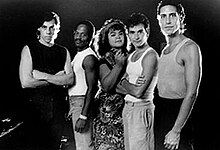 Romeo Void (left to correct): Frank Zincavage, Aaron Smith, Debora Iyall, Peter Wood, Benjamin Bossi | |
| Background information | |
| Origin | San Francisco, California |
| Genres | New wave, post-punk |
| Years agile | 1979–1985, 1993, 2004 |
| Labels | 415, Columbia |
| Website | romeovoid |
| Past members | Debora Iyall Peter Woods Frank Zincavage Jay Derrah Benjamin Bossi John "Stench" Haines Larry Carter Aaron Smith |
Romeo Void was an American new wave/mail service punk ring from San Francisco, California, formed in 1979.[1] The band primarily consisted of saxophonist Benjamin Bossi, vocalist Debora Iyall, guitarist Peter Forest, and bassist Frank Zincavage. The band went through 4 drummers, starting with Jay Derrah and ending with Aaron Smith. The band released three albums, It'southward a Condition, Distributor and Instincts, along with ane EP. They are best known for the songs "Never Say Never" and "A Daughter in Trouble (Is a Temporary Affair)"; the latter became a Summit 40 popular single.
The ring was started at the San Francisco Art Institute by Iyall and Zincavage. They released a single on the recently formed 415 Records earlier recording their debut album, which has been deemed a "masterpiece of American post-punk".[1] The success of their 2d release, a four-song EP, Never Say Never resulted in a distribution deal with Columbia Records. The ring continued to release music and tour until they broke upward in 1985. The members have reunited briefly over the years. Iyall has continued to pursue music as a side project. Iyall garnered acclaim as a skilled lyricist who explored themes like sexuality and breach from a female person perspective with "searing imagery".[1]
1979: Formation [edit]
Romeo Void formed at the San Francisco Art Institute in Feb 1979. Vocalist Debora Iyall occasionally visited the Bay Area to see Patti Smith perform.[2] She decided to pursue an art education after reading a fortune cookie. "It was in the late '70s at the Indochina Friendship Booth at the annual Fourth of July streetfair in Eureka, California," she said. "I got a fortune cookie that said 'Fine art is your fate, don't fence.' That adjacent January, I was enrolled in an fine art school in San Francisco."[iii] She began frequenting the Mabuhay Gardens, a popular nightclub, to see local alternative stone groups like The Nuns, the Mutants, Crime, and the Avengers.[two] She too formed the Mummers and Poppers, a punk parody band that covered 1960s tunes with guitarist Peter Woods, Charles Hagan and drummer Jay Derrah, .[1] [4] Iyall was originally hesitant to perform because she was overweight: "Afterwards seeing Patti Smith, I still had information technology in my listen that you had to be skinny to exist up there [on stage], but after going to the Mabuhay [...] you just do whatsoever you want, be whoever yous want, only go far happen."[ii]
Bassist Frank Zincavage met Iyall at the SF Art Establish; the 2 hit it off and discussed putting a band together. They formed one with Wood and Derrah a few weeks later,[4] drawing inspiration from the "burgeoning local punk and post-punk scenes".[1] Iyall recruited Woods because she enjoyed playing with him in the Mommers and Poppers. "[Information technology] seemed only natural that nosotros invite Peter Woods to join us [... He] played clean and was a natural on rhythm guitar."[3] Romeo Void officially formed on Valentine's Day in 1979. According to Iyall, the proper name Romeo Void referred to "a lack of romance" and came to mind afterward they saw a local mag with the headline "Why single women can't get laid in San Francisco."[1] The name "means there are non romantic notions hither — and there shouldn't be," Iyall told an interviewer: "We are about reality, non the myths created by other artists."[v]
The band practiced in Iyall'due south flat in Mission Commune.[3] Information technology was decided that the group would embrace punk ethics despite the possibility that they go associated with the new wave movement. "Even though I was going to the [Mabuhay Gardens] so much, I besides had criticisms: Everyone was leaning against the wall wearing black," Iyall said. "I guess we were considered new wave, but for me Romeo Void was a reaction confronting the regimentation of everyone having to be bleached blond and everything being about despair and no futurity, when I thought the do-information technology-yourself affair should encompass all the dissimilar kinds of emotions, and all the unlike colors. [...] I was proud of being American Indian, so I purposely never bleached my pilus blond."[2]
1980–1982: It's a Condition, Benefactor, and mainstream success [edit]
The band became busy playing shows at clubs and warehouses around San Francisco,[three] and quickly became popular.[2] Saxophonist Benjamin Bossi was added to the lineup as an "accident" when Iyall met him while he worked in the New York City Deli on Marketplace Street in San Francisco.[4] The group released their get-go single, "White Sweater", which consisted of the title track and a embrace of Jerry Lordan's popular instrumental limerick "Apache", in Feb 1981 on a recently founded local label called 415 Records.[1] They worked on the recording of their debut anthology, It's a Status, with producer David Kahne. Before recording began, Derrah left the ring and was replaced past John "Stench" Hanes, who had previously played with Pearl Harbor and the Explosions.[one] Romeo Void's debut was critically acclaimed upon its release through 415 in July 1981,[ane] [5] and introduced Romeo Void's "unique blend of jazz, funk, rock and confrontational poesy".[6] AllMusic writer Stewart Mason later heralded information technology as one of the "masterpieces of American post-punk".[one] Indie labels were enthusiastic with promotions and the band embarked on several nationwide tours.[7] Eventually Haines left the band, leaving Larry Carter to fill the drummer position.[viii]
The sudden surge in popularity was disorienting to Iyall. "It was frightening: we played a college in Santa Barbara, and there were all these blond people crowding the stage, and I thought 'These are the people who hated me in high schoolhouse!' When you grow upward beingness 'outside' – considering I wasn't white, and I was fat, and e'er a bit of a free thinker – it was strange. It was like, 'uh-oh, I must be doing something wrong – they like me!'"[ii] Highly successful mainstream artists like Ann Wilson and Ric Ocasek were eager to run across the ring. Ocasek extended an invitation to interact at his Synchro Sound studio in Boston.[2] The recording sessions in Boston resulted in the Never Say Never EP in January 1982. The championship rails became (arguably) their best-known song and has remained synonymous with the band ever since. The song was as well featured in the 1984 romantic teen drama Reckless. Additionally, the success of the single directly led to 415 Records signing a deal with Columbia Records, which elevated the indie label's roster to major-label status.[i] Romeo Void released their 2d anthology, entitled Benefactor, in November 1982.[9] The album appeared at No. 119 on the Billboard 200.[x] Distributor was noticeably more commercial sounding than previous endeavors; the music was made more danceable and swearing was removed on the song "Never Say Never".[9] The unlike approach in the sound resulted in comparisons to Blondie,[eight] which AllMusic writer William Ruhlmann suggested was a deliberate attempt past Columbia.[ix] Iyall stated that in that location was more pressure to write sexually laced lyrics for Benefactor: "I do like to exist provocative, and I definitely accept access to my sexuality, and equally a topic I observe information technology ripe, but I wasn't ever going to exist a sex-pot diva, so that was kind of odd." She also said there was pressure level to produce more than singles.[7]
1983–present: Instincts, pause-up, and post-band endeavors [edit]
A third and concluding album was over again helmed by David Kahne, which AllMusic author Stewart Mason speculated was a "reaction against the more commercial sound of Benefactor.[11] By this fourth dimension, Carter had been replaced by veteran session drummer Aaron Smith.[8] Instincts was released in October 1984, debuted at No. 68 on the Billboard 200,[10] and proved to be the band's best-selling anthology.[eleven] It also launched their most successful single, "A Girl in Trouble (Is a Temporary Thing)," which broke the Billboard Top 40 and peaked at No. 35.[ten] Critical reactions were positive.[12] Despite being the band's most successful effort to engagement, Columbia pulled the ring's promotional support while on a nationwide tour. "The very side by side boondocks we got to later they made that decision, there wasn't an A&R person in that location," said Iyall. "[In that location] was no local person there, there were no interviews and in-stores bundled as they had been. All that but basis to a halt." The band returned to San Francisco and soon broke up. Constant touring has been cited by Iyall as the primary reason for the interruption-upwardly. "You become tired of each other, and you become intolerant of being uncomfortable and away from your family and your friends."[7] According to a VH1 reunion episode, the issue of Iyall's weight was the reason for the label dropping them.[7] In 2003, Iyall agreed with this claim: "Howie sold u.s.a. from 415 to Columbia Records, and they were like 'Who's this fat chick?' They decided that was as far every bit information technology was going to get, and pulled their back up."[2] Crawdaddy! author Denise Sullivan stated that the characterization spoke to Iyall about losing weight, only she after refused.[xiii] In 2010, Iyall declined to discuss the event, but added that she may non be taking full responsibleness in the matter.[7]
Iyall released a solo album entitled Strange Language with former band members Bossi and Smith in 1986.[fourteen] Afterward she pursued a career as an fine art instructor.[1] The band reunited briefly for a alive performance in 1993.[viii] In 2004, Romeo Void was featured on an episode of VH1's Bands Reunited. Bossi had sustained too much hearing impairment over the years and was unable to perform, although he did come across up with the ring again and watched the reunion performance from an adjacent room.[xv] Iyall has continued to dabble in music related projects and events. "I still similar to sing and I even so like to perform," she said.[7] In 2003 she was involved in a musical project called Pocketknife in Water.[2] She began collaborating with Peter Dunne, who was known as Peter Bilt when he played guitar for Pearl Harbor and the Explosions. Iyall and Dunne performed at a support benefit for Crawdaddy! founder Paul Williams in June 2009,[xvi] and performed at a concert honoring 415 Records subsequently that September.[17] They released an album entitled Stay Potent in 2010.[13]
Music [edit]

Romeo Void has generally been classified as a new moving ridge[thirteen] [xx] or postal service-punk ring.[one] [4] [21] Some critics take noted dance elements in the music.[6] [thirteen] [22] According to Stewart Mason, writing for AllMusic, "[The] band's muscular blend of Joy Sectionalisation's altercation and the Gang of Four's rattling momentum, with Benjamin Bossi's splattering free jazz saxophone coloring everything, made Romeo Void ane of the strongest of the American post-punk bands.[1] The St. Petersburg Times wrote that they "had no trouble creating a signature audio for [themselves with a] scratchy guitar, soulful sax, [and] tight, precise drums."[20] The New York Times stated that they sounded like "an art-school band, with its textural complexity [and] touches of jazz and funk"[23] Saxophone player Benjamin Bossi has been observed as the ingredient that "ready the band apart" and showed a "talent for both improvisation and arrangement."[24] Alan Niester, writing for The Globe and Mail, said that he weaved "in and out [...] like a snake charmer" and reminded him of Andy Mackay, a saxophonist that played with Roxy Music.[21]
Liam Lacey, also writing for The Globe and Post, described Iyall's voice as "sultry [and] sexy",[25] while Mason called information technology "powerful".[1] Her fashion has sometimes been compared to Chrissie Hynde, vocalist for the Pretenders.[24] [25] Richard Harrington of The Washington Post acknowledged the similarity, but also noted the influence of other singers in "Never Say Never" where Iyall mixed the "aggressive bitchiness of [Hynde], the coy confrontational tactics of Patty Donahue of the Waitresses and the slack sensuality of Debbie Harry of the earliest Blondie."[26] Iyall used to find the comparing annoying, merely eventually warmed to it: "When people said I sounded like her, I'd say, 'Oh yeah, thanks a lot.' But this year, I've fallen in beloved with Learning To Crawl and then now I don't care if people desire to brand comparisons."[25] After a alive show in 1982, Niester contended that she was the weakest part of the grouping and had the "vocal range of an motorcar horn".[21] Billboard writer Kathy Gillis wrote after a concert two years later that Iyall exhibited a "dramatic range that, while non extreme in either direction, was touching."[12]
Patti Smith had a neat influence on Iyall.[26] "[She was] someone who was both a stone singer and a poet," she said. "She combined things I was interested in. Plus, she wasn't a trumped-up sex symbol. She was herself on phase. That appealed to me. It looked like something I could do. You didn't have to look like all the other singers."[4] Iyall was highly critical of the music of the day and institute inspiration in other mediums. "I detest rock and roll right now. Information technology's turned into some new kind of stupid religion... I'd rather mind to Billie Holiday, peradventure Tom Waits. Actually, I'll admit I like The Bangles – they have a bully audio. But I'd merely as soon read novels or paint pictures every bit mind to music. I love language – plain spoken communication, used in an enigmatic, subliminal way; I'yard not much tied to the literal."[25]
Lyrics [edit]
Iyall was observed by Female parent Jones to be amid a new grouping of female fronted rock bands that displayed a "tough, wry, street-wise, [and] contemptuous" attitude and sought to redefine the part of women in rock music.[27] She adult a sizable post-obit for her writing that covered topics similar "frustrated desire [and] sexually motivated rage" from a female perspective.[23] Critics praised her lyrics for their "searing imagery",[ane] "seething poetics",[13] and "[nighttime intelligence]"[vi] "My approach was ever that I had something to say, I had a point of view," Iyall said, commenting on her outspokeness. "I think seeing Penelope from the Avengers at the Mabuhay Gardens and thinking, I can exercise that. I take something to say."[7]
Romeo Void'south best known song is "Never Say Never", which contains the famous line "I might like you better if we slept together."[7] AllMusic writer Heather Phares has argued that Iyall'south "teasing, existential musings [...] predated and predicted the aloof nevertheless frank sexuality of early on- and mid-'90s artists such every bit Elastica and Liz Phair". Phares ended that the song was "a destructive, influential classic" and "ane of new wave's most distinctive and innovative moments. "[18] The song has been covered by many artists,[13] among them are Queens of the Rock Age and Amanda Blank.[28] [29] The song "A Girl in Problem (Is a Temporary Thing)", their highest-charting single,[x] was reportedly written as a response to Michael Jackson'due south hit song "Billie Jean", simply can also be seen as a tribute to women who accept experienced traumatizing events.[19] Iyall also wrote songs that touched on themes like social alienation ("Undercover Kept") and generation gaps ("Chinatown").[26]
Personnel [edit]
Classic line-upwardly
- Debora Iyall – vocals (1979–1985, 1993, 2004)
- Peter Woods – guitar (1979–1985, 1993, 2004)
- Frank Zincavage – bass (1979–1985, 1993, 2004)
- Benjamin Bossi – saxophone (1980–1985, 1993)
- Aaron Smith – drums, percussion (1984–1985, 1993, 2004)
Previous members
- Jay Derrah – drums, percussion (1979–1981)
- John "Stench" Haines – drums, percussion (1981)
- Larry Carter – drums, percussion (1981–1984)
- Sheldon Dark-brown – saxophone (2004)
Discography [edit]
Albums and EPs [edit]
| Year | Title |
|---|---|
| 1981 | Information technology'southward a Status |
| 1981 | Never Say Never (EP) |
| 1982 | Benefactor |
| 1984 | Instincts |
| 1992 | Warm, in Your Coat (compilation) |
Singles [edit]
| Year | Title |
|---|---|
| 1981 | "Myself to Myself" / "White Sweater" |
| 1982 | "Never Say Never" |
| 1982 | "Underground Kept" |
| 1984 | "A Girl in Trouble (Is a Temporary Thing)" |
| 1984 | "Say No" |
References [edit]
- ^ a b c d e f k h i j grand fifty m n o p Mason, Stewart. "Romeo Void biography". AllMusic. All Media Network. Retrieved February 21, 2011.
- ^ a b c d e f g h i Bielawski, Toby (January 1, 2003). "Punk Prophets". East Bay Express. Retrieved February 21, 2011.
- ^ a b c d Michaels, Randolph (2005). Flashbacks to Happiness: Eighties Music Revisited. iUniverse. p. 156. ISBN0-595-37007-1.
- ^ a b c d e Gimarc, George (1997). Postal service Punk Diary: 1980–1982 . Macmillan Publishers. p. 135. ISBN0-312-16968-X.
- ^ a b Riegel, Richard (December 1982). "Romeo Void: Distributor". Creem . Retrieved September 14, 2019 – via Rock's Backpages.
- ^ a b c Payes, Robert (2011). "Romeo Void biography". Trouser Press. Retrieved February 21, 2011.
- ^ a b c d e f thousand h Evans, Kirsty (April 14, 2010). "Debora Iyall Fills a Void". East Bay Limited. Retrieved February 21, 2011.
- ^ a b c d Strong, Martin Charles (2003). The Not bad Indie Discography. Canongate U.Due south. p. 487. ISBN1-84195-335-0.
- ^ a b c Ruhlmann, William (2011b). "Benefactor review". AllMusic. All Media Guide, LLC. Retrieved February 21, 2011.
- ^ a b c d AllMusic staff (2011). "Romeo Void charts and awards". AllMusic. All Media Guide, LLC. Retrieved February 21, 2011.
- ^ a b Ruhlmann, William (2011c). "Instincts review". AllMusic. All Media Guide, LLC. Retrieved February 21, 2011.
- ^ a b Gillis, Kathy (December 1984). "Talent in Action: Romeo Void". Billboard. No. 90th Anniversary Special Edition.
- ^ a b c d e f Sullivan, Denise (December 23, 2010). "What Makes a Fable: Debora Iyall". Crawdaddy!. Retrieved Feb 21, 2011.
- ^ Mason, Stewart (2011). "Foreign Language review". AllMusic. All Media Guide, LLC. Retrieved February 21, 2011.
- ^ Bernstein, Jonathan (February 2004). "Jonathan Bernstein's Aerial View of America". The Guardian. p. 98.
- ^ Rolling Stone staff (June 23, 2009). "Rockers Unite for Benefit Supporting Crawdaddy! Founder Paul Williams". Rolling Stone. Retrieved Feb 21, 2011.
- ^ Selvin, Joel (October 4, 2009). "S.F. concert in honor of 415 Records". San Francisco Chronicle. Retrieved Feb 22, 2011.
- ^ a b Phares, Heather (2011). "Never Say Never review". AllMusic. All Media Guide, LLC. Retrieved Feb 21, 2011.
- ^ a b Horowitz, Hal (2011). "A Girl in Trouble (Is a Temporary Thing) review". AllMusic. All Media Guide, LLC. Retrieved February 21, 2011.
- ^ a b Hall, Dave; Siegel, Kristi (June 1992). "Sound Bites: Pop". St. Petersburg Times. p. 21.
- ^ a b c Niester, Alan (Nov 1982). "Romeo Void's 'postal service-punk' Draws a Blank". The World and Post.
- ^ Ruhlmann, William (2011e). "Warm, In Your Glaze review". AllMusic. All Media Guide, LLC. Retrieved February 21, 2011.
- ^ a b Palmer, Robert (August 1982). "The Pop Life". The New York Times. p. nineteen.
- ^ a b Mariotte, Michael (November 1984). "Romeo Void". The Washington Post. p. B4.
- ^ a b c d Lacey, Liam (November 1984). "Riff Rap: Pb singer of Romeo Void speaks out on rock and coil". The Globe and Mail service.
- ^ a b c Harrington, Richard (September 1982). "Lovelorn Translator, Loveless Romeo Void". The Washington Post.
- ^ Talbot, David (July 1981). "New Wave Rockettes!". Mother Jones. Foundation for National Progress. 6 (half-dozen): 7.
- ^ Roth, Kristin (September 29, 2000). "Queens of the Stone Age Talk Bout". Rolling Stone. Retrieved February 21, 2011.
- ^ Elan, Priya (October 3, 2009). "Why we're Gaga for Amanda Blank". The Guardian . Retrieved February 21, 2011.
External links [edit]
- Official website
Source: https://en.wikipedia.org/wiki/Romeo_Void
0 Response to "Romeo Void Never Say Never Art of Mix Lyrics"
Post a Comment